A Blues Enigma,
Robert Johnson
By Andrew Chanler 12/98 - 1/99
Many of the important blues classics, like "Sweet Home Chicago", "Crossroads", and "Rambling on My Mind" were written and recorded decades before they became famous songs. The life of the man who wrote these songs is still a mystery, but his influence on modern musicians like Eric Clapton and Led Zeppelin is without question. Robert Johnson was one of the most creative blues musicians in the 1930’s and has influenced musicians and music styles for many decades.
Robert Johnson’s Mythological Beginning:
Robert Johnson grew up on Dockery’s plantation. There he made up his mind to become a blues musician. He was instructed to take his guitar to the crossroads at midnight. He was met there by the Devil himself who grabbed his guitar tuned it and gave it back to him. From that day on Robert had supernatural powers which enabled him to play better than any blues musician ever heard. Legend has it that at the end of his life he was foaming at the mouth and snapping at people like a dog. His dying words were supposedly, "I pray that my Redeemer will come and take me from my grave."(Brooks 53)
Robert Johnson’s Factual Beginning:
Robert Johnson was born on the May 8, 1911 in Hazelhurst, Mississippi. His mother was Julia Major Dodds and his father was Noah Johnson, but went by the name Robert Spencer, the name of his stepfather who had changed his name from Dodds when trying to escape from the Marchetti brothers. His mother signed on with a Delta labor supplier and took Robert and his sister, Carrie, with her. After a couple of unsettled years they were living in Memphis with the large Spencer family. Julia decided to make her own way in life and left her children with the Spencers.
In 1918 the Spencers thought Johnson needed more supervision so they took him to live with his mother in Robinsonville, a small but thriving Mississippi cotton community. In his teens he took his real father’s name although he never met his real father. He began to be interested in music and started to play the Jew’s harp and the harmonica. Johnson quit school with the excuse that he had bad eyesight.
In 1929, before he could play guitar, he married Virginia Travis. In the summer of 1929 Virginia became pregnant and Johnson was a proud expectant father. Whatever hopes and dreams he had for his wife and family came to a sudden crash in April 1930. Both Virginia and the baby died in childbirth. She was only 16 years of age. "He was a man fighting against dark and unknown forces within himself."(Busnar 119)
In June 1930 Son House, a blues musician came to live in Robinsonville. When Johnson first heard House’s music he was deeply effected, for it was the "rawest, most direct pure emotion Johnson had ever heard, and he followed House and [Willie] Brown wherever they went."(Danforth)
Johnson did not appear to be musically talented at first. Son House said, "Such another racket you never heard! It’d make people mad, you know. They’d come out and say, "Why don’t y’all go in there and get that guitar from that boy!"(Danforth) Johnson soon learned to play guitar by listening and watching others play.
Back in Hazelhurst, MS he found a "kind and loving woman more than ten years his senior"(Danforth) named Calletta "Collie" Craft. They were married in May 1931 but kept it secret. Here Johnson played at the "jook joints of the road gangs and lumber camps".
Johnson’s biggest influence was a mysterious blues musician named Ike Zinneman. Johnson would follow Zinneman to the local graveyard where Zinneman liked to practice at night. "What Johnson learned while sitting in the dark, leaning against a gravestone is purely speculative, but after one year under Zinneman’s tutelage, Johnson returned home a musical giant."(Brooks 55) Now not only could he play and sing anything from country to hit pop songs to polkas but could also write songs as well. Johnson’s other early influences were Charley Patton, Willie Brown, Son House for his slide style and inspiration, and Lonnie Johnson for his guitar tone and texture.
Johnson was now reaching the peak in his musical talent. He went back to Robinsonville. Son House and Willie Brown were astounded by his development and unique style. Rumors were soon made that he had sold his soul to the Devil in exchange for the guitar expertise. Other then the myths and rumors very little is known about how he acquired his extraordinary skill, as both a songwriter and guitarist, in such a brief time.
Robinsonville was a farming community and Johnson was finally no farmer. He left for Riverside, Arkansas, one of the most musically active towns in those days. Johnson spent much of his time traveling from one small town to another and wherever he was scheduled to play, people showed up (LaVere 14).
Johnson developed a very unusual talent. He could hear a piece of music from the radio or the phonograph or a live musician and he could later play it back note for note. He could be in deep conversation with a group of people and hear something, never stop talking, and later sing and play it perfectly. This amazed many people and they could not understand how Johnson could do this (LaVere 16).
Johnson decided he wanted to record his music just like his mentors Son House, Willie Brown, and Charlie Patton had done. In November 1936 Johnson traveled to San Antonio, Texas to record under the Vocalion Record label. They recorded 11 singles and 6 were still in the Vocalion Catalog in 1938. Although he recorded some of his best music ever, none of his songs sold as well as "Terraplane Blues". Then in June 1937 Johnson went to Dallas, Texas to record more of his work. He recorded 18 new singles that were more beautiful and more powerful then his other recordings. Unfortunately there would be no more recording sessions.
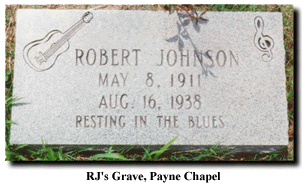
One August Saturday night in 1938 Johnson was playing in Three Folks, Mississippi. Little did he know but this would be his last time to perform live to anyone. "The Story goes that Robert was flirting with a woman at the dance, and her jealous husband or boyfriend decided to get even by serving the singer a jug of moonshine whiskey with a cake of lye floating in it. Johnson kept drinking and playing until he was too sick to continue. He was taken to nearby Greenwood where, after an excruciating few days, he died of pneumonia on the 16 of August 1938. He was 27."(Brooks 55)
"In every generation of blues there’s always somebody who’s the best. These are the people that everybody follows because their sound is new and different. Just like T-Bone Walker was the tops for his day and B.B. King is today, well, Robert Johnson was the greatest of his day."(Brooks 56)
In 1990 Columbia Records put out The Complete Recordings of Robert Johnson, a two-disc set with extensive liner notes and rare photos. Columbia only expected to sell about 20,000 copies but when it came out it sold nearly half a million copies. And to top that it won a Grammy Award.
Robert Johnson influenced blues music forever with his new way of playing a boogie-woogie bass line on the low strings of the guitar. Before Johnson, boogie-woogie had been mostly played on the piano. Johnson’s style of guitar boogie-woogie caught on quickly in the Delta blues community, and soon spread north to Chicago. It was an important part of the electric Chicago blues style, as played by Eddie Taylor, Hound Dog Taylor, Jimmy Reed, and Elmore James (Logan 35).
The origins of blues music can be traced through a long history of African-American culture. Of all the Mississippi Delta blues musicians, Robert Johnson made the most significant contributions to the modern development of the blues style. He had a photographic memory for notes, an amazing natural ability to play any song he heard. He was able to synthesize all the various types of blues music anyone could play. This ability made Johnson the most influential blues artist of all time.
"It is safe to say that no one who has surfaced since Robert Johnson’s passing has been able to match his unconventional guitar accomplishments, save, perhaps, Jimi Hendrix"(The Blue Flame Café).
Modern performers who were influenced by Robert Johnson and recorded his songs (Danforth):
Also: Rory Block, Steve Goodman, Lee Roy Parnell, Turtle Island, Bluerunners, Bob Margolin, Railroad Jerk, Hank Williams, Jr., Cowboy Junkies, George Gritzbach, Robert McEntee, Cassandra Wilson, Rory Gallagher, Eric Johnson, Bill Morrisey, Warren Zevon, John Fogerty, Chris Whitley, Chris Smither, Artie Traum, Jonnell Mosser, Blue Moon Swamp, Curtis Chapman, Steve Earle, Bleeker Street, Ben Harper, Asleep at the Wheel.
Writer Greil Marcus summed up questions Robert Johnson asked in his Music (Busnar 119):
Bibliography
(Left) CD cover to Columbia Records’
Robert Johnson: The Complete Recordings
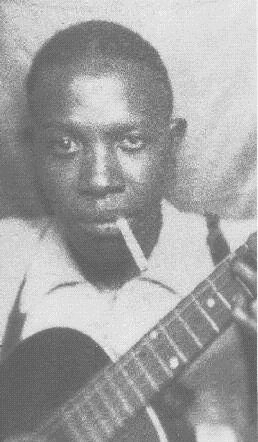
Also it is one of the two only known photographs of Robert Johnson.
(Right) The other of the two only known photographs of Robert Johnson.

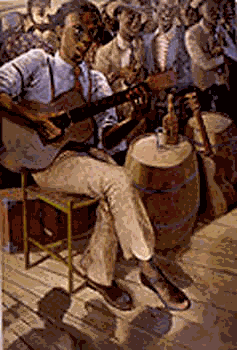
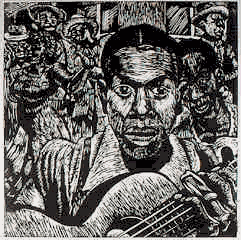


This artwork that has been inspired by Robert Johnson’s Music.
Art By Matthew LaRose.
By Robert Johnson
I went to the crossroad
fell down on my knees
I went to the crossroad
fell down on my knees
Asked the Lord above "Have mercy, now
save poor Bob, if you please
Mmmmm, standin' at the crossroad
I tried to flag a ride
Standin' at the crossroad
I tried to flag a ride
Didn't nobody seem to know me
everybody pass me by
Mmm, the sun goin' down, boy
dark gon' catch me here
oooo ooee eeee
boy, dark gon' catch me here
I haven't got no lovin' sweet woman that
love and feel my care
You can run, you can run
tell my friend-boy Willie Brown
You can run, you can run
tell my friend-boy Willie Brown
Lord, that I'm standin' at the crossroad, babe
I believe I'm sinkin' down
The lyrics to Robert Johnson’s song "Crossroad Blues". This song gave people an explanation as to how he became so talented at playing the blues. The myth about meeting the devil was born.